

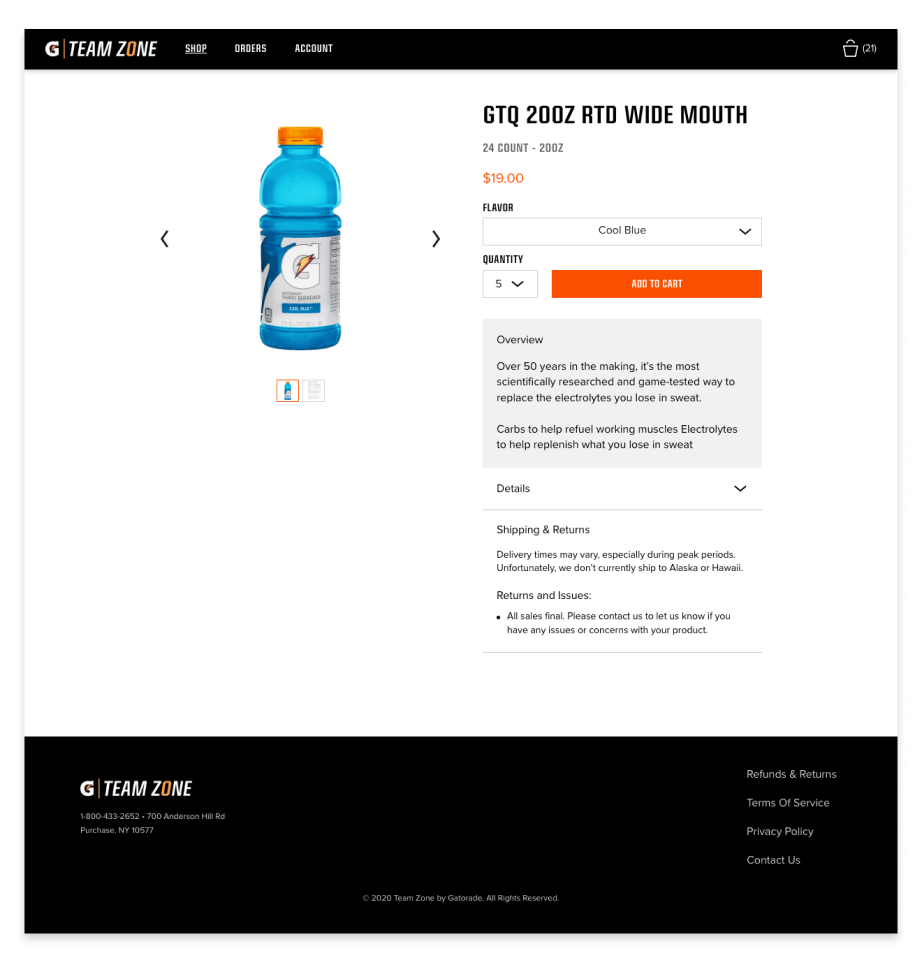
Replaced a two-person, manually maintained ordering system with TeamZone — a self-service e-commerce platform that gives Sports Directors, Dietitians, and Trainers direct visibility into orders, inventory, and shipping status when spending their team’s seasonal Gatorade allocation.
The problem
The existing process ran through two employees manually entering data, managing accounts, and handling order errors across outdated, disconnected systems. Sports team staff had no visibility into order status or product availability — leading to confusion, rushed last-minute orders, and, for Gatorade, missed revenue opportunity.
The process
Started with a component library built from existing brand elements, then ran user interviews to validate the two core pain points: lack of order/inventory visibility, and general workflow confusion. Initial concepts focused on order management and creation, based on how teams actually order — in large, infrequent batches rather than steady one-off purchases.
Time constraints forced a pivot midway: instead of the more novel order-management-first approach, the design moved to a more conventional e-commerce pattern that could ship within the window. Prototyping moved from Figma to Adobe XD to speed iteration, validated against Baymard Institute benchmarks for e-commerce best practice. Delivered components and page models directly to engineering, staying embedded through grooming to hit the timeline.
My role
Senior UI/UX Designer, alongside a design lead (also Senior UI/UX Designer). Owned wireframes, user flow diagrams, and high-fidelity comps; contributed to the interactive prototype and the final research deck handed to Pepsi Ecomm for future platform work.
The result
Shipped an MLP (minimum loveable product) in three months. Teams get direct access to orders, allocations, and shipping status without routing through manual staff intervention — closing the visibility gap that was the core complaint. Order-volume and efficiency gains are the expected outcome of that fix, not yet a measured one.
What I’d do differently
The pivot to a conventional e-commerce pattern was the right call under the timeline, but it left the more interesting idea unexplored: designing specifically around how teams actually order — in large, infrequent batches — rather than ad