

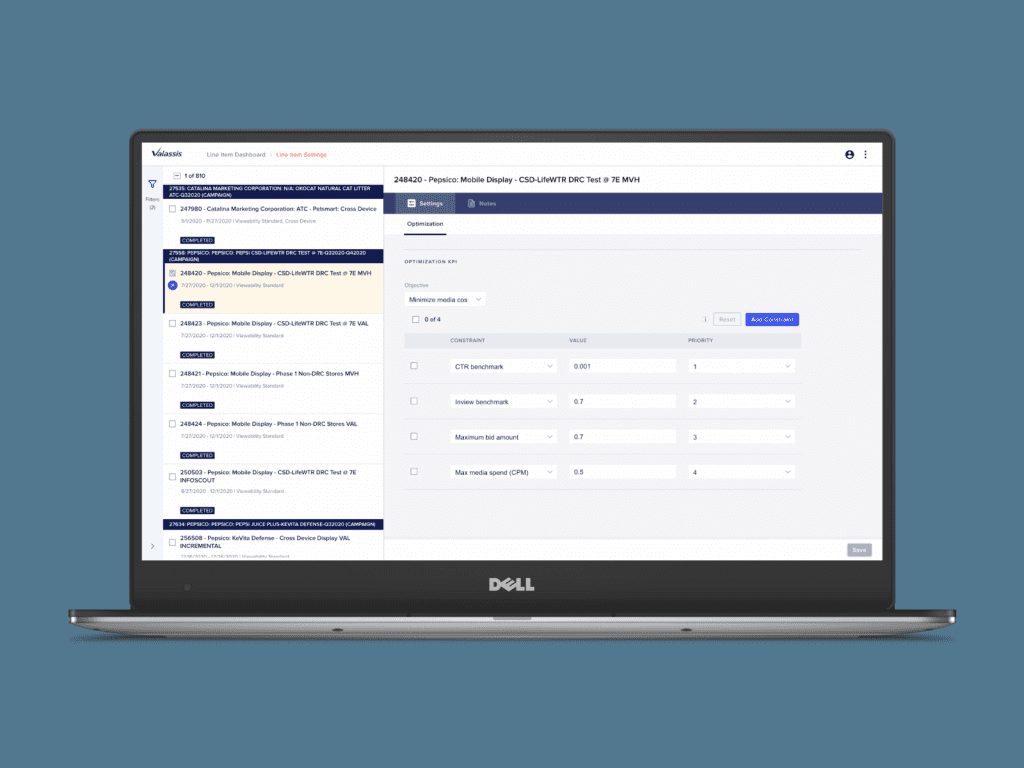
Built a self-service optimization tool that closed a critical knowledge gap at Valassis — giving less-technical Business Analysts the ability to run live campaign adjustments that had been bottlenecked on a small group of Data Scientists working in Python, R, and Jupyter notebooks.
The problem
Campaign monitoring and optimization ran through a handful of highly technical staff. That concentration created a knowledge gap, a delivery bottleneck, and a single point of failure — most Business Analysts couldn’t participate in optimizing the campaigns they owned.
The process
Started with an experimental interface, built with the lead engineer and released to a small group of Data Scientists, to learn what optimizations people actually made and why — usage data, not assumptions, shaped the direction. That fed a formal discovery phase: stakeholder interviews, contextual inquiries, and a design workshop where task-modeling exercises and paper-sketch exercises surfaced Business Analysts’ real workflow gaps.
From there: static wireframes to narrow scope and align the team, then rapid prototyping to work through interaction patterns once the core functionality was clear. Delivered components and page models directly to engineering, staying embedded through cross-team grooming to hit sprint milestones across two quarters. Post-launch, we built a feedback loop to keep iterating.
My role
Senior Interaction Designer on a four-person team — a senior visual designer, a senior researcher, and a research intern. Led the experimental-interface build with the lead engineer, ran discovery interviews alongside the research team, and owned wireframes through prototyping and engineering handoff.
The result
Business Analysts gained the ability to balance workloads and optimize campaigns directly, without routing through a technical bottleneck — faster insight into campaign performance, lower operating costs, and better delivery for clients.
What I’d do differently
System communication and feedback were the weak point — the tool didn’t give users clear enough signal on what changed and why after an optimization. Given the scope and timeline, it’s the piece I’d prioritize differently next time.